Great Migration Safari: Northern Serengeti
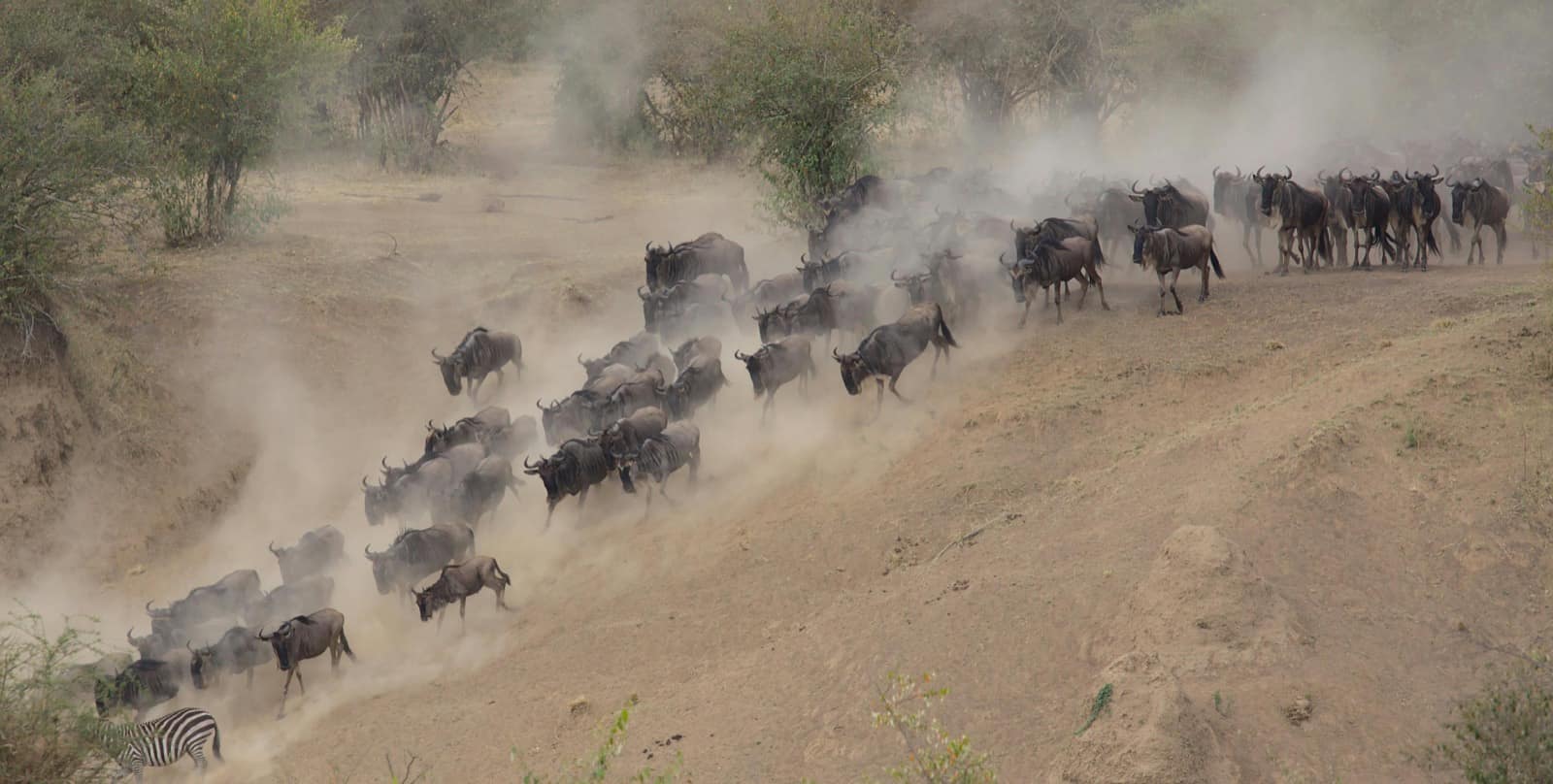
The Mara River crossing is the thing most people picture when they think of Africa. What the photographs do not convey is the waiting. Herds of hundreds of thousands mass on the south bank, press to the edge, pull back. A single wildebeest commits and the whole thing breaks. The river is forty metres wide and full of crocodiles. The crossing takes about four minutes. Then silence, and the herd rebuilds on the far bank. This 10-day route puts you at Kogatende with three nights at the crossing points. Three nights is the minimum for meaningful odds. August and September are the peak months. The crossing cannot be promised on any specific day. That is not a qualification. It is what makes it worth coming.
Safari Overview
Tanzania's national aerial census in 2023 (TAWIRI, co-conducted with Frankfurt Zoological Society and the University of Glasgow) counted 1,366,109 wildebeest in the Greater Serengeti. A 2025 Oxford satellite study suggested the number may be lower, around 800,000; the gap is unresolved and under active scientific review. The commonly cited figure of 1.5 million conflates wildebeest with zebra and Thomson's gazelle. Two million has no primary source. Whatever the exact count, when the bulk of the herd reaches the northern Serengeti from late July onward, the scale is unlike anything else in Africa. The migration runs on rainfall, not calendar. Year-to-year variance in arrival timing can be four to six weeks. In June, herds are in the Western Corridor crossing the Grumeti. The vanguard typically reaches Kogatende from mid-July. August and September are the peak months for Mara crossings. By late October the short rains approach, herds begin moving south, and the window closes. A booking past October 20th carries real risk of missing the crossings entirely. The Mara River at Kogatende has ten to twelve TANAPA-designated crossing points. Crossings 4 and 5 are the most dramatic, with steep banks and deep pools. Crossing 2 is the most photogenic. Crossings 9 through 12 have the fewest vehicles. On a three-to-four night August stay, the probability of seeing at least one major crossing is roughly 80 percent. Four to five nights push the odds meaningfully higher. This itinerary gives you three full days at the river, then drives south through the central Serengeti to Ngorongoro Crater on the return.
Your Itinerary
Activities
Transfer from Kilimanjaro International Airport to your Arusha hotel, about 45 minutes on a clear day. Dinner and a full briefing: crossing point geography, TANAPA rules at the Mara, what to realistically expect. The drive to the Serengeti begins in the morning.
Accommodation
Arusha Coffee Lodge or similar
Meals
Dinner
Prices
Migration season (July–October)
| Tier | 2 guestsper person | 4 guestsper person | 6 guestsper person |
|---|---|---|---|
Comfort Comfortable tented camps including a mobile camp at the Mara River, full board, fully private. Mawe Gnu Migration Camp (Kogatende), Tortilis Serengeti | $6,210 | $4,885 | $4,445 |
Premium Upgraded tented camp at Kogatende, positioned for the river crossings. Ang'ata Migration Camp (Kogatende), Gran Meliá Arusha | $6,900 | $5,570 | $5,125 |
Luxury Premium migration camps minutes from the crossing points, the top of our range. Lemala / Elewana migration camps, Arusha Coffee Lodge | $9,975 | $8,645 | $8,200 |
Comfortable tented camps including a mobile camp at the Mara River, full board, fully private.
Mawe Gnu Migration Camp (Kogatende), Tortilis Serengeti
- 2 guests (pp)
- $6,210
- 4 guests (pp)
- $4,885
- 6 guests (pp)
- $4,445
Upgraded tented camp at Kogatende, positioned for the river crossings.
Ang'ata Migration Camp (Kogatende), Gran Meliá Arusha
- 2 guests (pp)
- $6,900
- 4 guests (pp)
- $5,570
- 6 guests (pp)
- $5,125
Premium migration camps minutes from the crossing points, the top of our range.
Lemala / Elewana migration camps, Arusha Coffee Lodge
- 2 guests (pp)
- $9,975
- 4 guests (pp)
- $8,645
- 6 guests (pp)
- $8,200
Per person sharing, US dollars. The Mara River crossings run July to October, so there is no green-season rate for this trip. The 'from' price is the Comfort tier with six guests sharing the vehicle. Price drops as your group grows because the private vehicle and guide are shared across more people. Built from real lodge rates, our own vehicle, and current park fees. Three nights at Kogatende in the far north carry a remote-vehicle surcharge and northern-Serengeti concession fees, which is why a migration safari costs more than the standard circuit.
Migration Calendar: Month by Month
The migration runs on rainfall, not calendar. Year-to-year variance in arrival timing can be four to six weeks. The 2024 season saw the first Mara crossing on June 29th, unusually early. Treat the windows below as central tendencies.
June. The bulk of the herd is in the Western Corridor, approaching or crossing the Grumeti River. Grumeti crossings typically run from late May through early July. The Grumeti is narrower than the Mara (10 to 50 metres), crossing groups are smaller, and vehicle counts are much lower. The crocodile pods here are famously large: wildlife surveys from the 1990s recorded roughly three times the crocodile density of comparable Mara stretches. Worth seeing on its own terms, but it is not the Mara.
July. Transition. The vanguard reaches Kogatende mid-month in a typical year. Visitors arriving in the first half of July are better positioned starting in the Western Corridor and moving north rather than committing to Kogatende from day one. The first crossings of the season tend to be intense per-event (hungry crocodiles, smaller initial crowds) but timing is uncertain.
August. Peak. Herds concentrated in the Kogatende and Lamai Wedge areas. The most active crossing points are 4 and 5 (most dramatic), 2 (most photogenic), 7 and 10 (most consistent). Crossings cluster: multiple events in one morning, then days of massing without a crossing. Vehicle counts at the famous points are at their highest.
September. Comparable to August for crossings, materially fewer vehicles. Herd density at Kogatende slowly declines as a growing fraction has crossed into Kenya or begun the southward turn. Major crossings still occur throughout the month. The best month for the experience-to-crowd ratio. Photography conditions improve: lower sun angle, drier air.
October. Tail end with real risk. Crossings still occur in early to mid October. Nomad Tanzania recorded a Mara crossing on October 16th, 2024. After October 20th, the odds drop sharply in a typical year and short rains can trigger sudden southward movement. An October booking past the 20th is a genuine gamble.
What Happens at a Mara River Crossing
Wildebeest have no permanent dominance hierarchy. Any individual can initiate a crossing, which is why crossings cannot be predicted to the hour.
Behavioral research (Torney, Hopcraft et al., 2018, Philosophical Transactions of the Royal Society B) documents the mechanism: a small committed minority at the water's edge, sometimes fewer than a dozen animals, can tip the collective calculation of a herd of thousands. Once one wildebeest enters the water, the surrounding mass follows. The flip from hesitation to full commitment can happen in under a minute. Herds have also been documented massing on the bank for multiple days before turning back. This is a false start, not a malfunction.
The Mara at Kogatende has ten to twelve designated crossing points. Crossings 4 and 5 are the most dramatic; Crossing 2 is the most photogenic; Crossings 9 through 12 have the fewest vehicles. Guides track herd positions through field contacts each morning.
TANAPA's June 2024 crossing guidelines require vehicles to hold position at designated points, maintain 25 metres from the bank, stay stationary during crossing events, and never allow disembarking. In August 2025, TANAPA issued one-year professional bans to six guides from major operators, including Asilia and Nomad, for allowing guests to leave the vehicle at a crossing. The rules are actively enforced. Foot presence at the bank causes false starts and disrupts the crossing decision. Jumbo Safaris follows the rules. Every drive.
Northern Serengeti Camps and How to Get There
The camps within 30 minutes of the Mara crossing points divide by bank.
South bank (Kogatende side): Sayari Camp (Asilia Africa), Olakira Migration Camp (Asilia Africa, mobile June to October), Serengeti Bushtops, Lemala Kuria Hills. Morning light is best from this side: approaching herds are front-lit before 9:00am.
North bank (Lamai Wedge): Lamai Serengeti (Nomad Tanzania), Singita Mara River Tented Camp. Afternoon light is best here, with warm sidelight on animals emerging from the water.
All of these camps are seasonal, typically June through October, and August dates book out months in advance.
Getting there: two options. Driving from Arusha to the central Serengeti takes six to seven hours on paved road. Then Seronera to Kogatende is another 160 to 170 km on murram and dirt track, five to six hours in dry conditions. Night driving inside the park is not allowed. The drive through the Lobo Hills is a game drive throughout. Flying is the faster option: Coastal Aviation operates scheduled flights from Arusha to Kogatende Airstrip (GTZ), roughly 1.5 hours with intermediate stops. Flying removes two long transit days and adds one to two crossing sessions on a 10-day itinerary. Ask about fly-in pricing when you enquire.
Practical note: dawn at Kogatende in July through October runs 8 to 15 degrees Celsius. Bring a fleece for early departures.
What's Included
Included
- All Serengeti National Park conservation fees
- Ngorongoro Conservation Area fees and crater vehicle descent fee ($295 per vehicle)
- Private 4x4 Toyota Land Cruiser with pop-up roof
- Professional English-speaking guide, Arusha-based
- 9 nights accommodation as specified
- All meals (dinner Day 1 through lunch Day 10)
- Bottled water and soft drinks on game drives
- All road transfers throughout the circuit
- AMREF Flying Doctors emergency evacuation insurance
Not Included
- International flights
- Tanzania e-visa ($50 for most nationalities)
- Travel insurance
- Guide gratuity (suggested $25 per day)
- Lodge staff gratuity (suggested $5-7 per day via lodge tip box)
- Hot air balloon safari (optional, $599 per person, available in central Serengeti on Day 3)
- Alcoholic beverages
- Personal expenses
Common Questions
What is the best time to see the Great Migration in the Serengeti?
August and September are the peak months for Mara River crossings in the northern Serengeti. The herds are most concentrated at Kogatende, crossing events are most frequent, and predator activity is highest. July is viable but less reliable: the vanguard typically reaches Kogatende from mid-July, but timing shifts by four to six weeks depending on rainfall. First-half July visitors are better positioned starting in the Western Corridor and moving north. October is the tail end. Crossings still occur in early October, but after the 20th the odds drop sharply and short rains can trigger sudden southward movement. June targets the Grumeti River crossings in the Western Corridor, which are smaller in scale but far less crowded.
Can you guarantee seeing a river crossing?
No. Nobody can. Wildebeest mass on the Mara bank for multiple consecutive days and turn back without crossing. On a three-night August stay at Kogatende, experienced operators put the probability of seeing at least one major crossing at roughly 80 percent. Three nights gives you six sessions at the crossing points. Four to five nights push the odds meaningfully higher. The northern Serengeti also has exceptional resident game year-round regardless of crossings: lion, leopard, cheetah, elephant, buffalo. Every drive has a point regardless of what the herd does.
Why do wildebeest hesitate before crossing?
There is no lead animal. Wildebeest have no permanent dominance hierarchy, so the crossing decision is collective. Behavioral research (Torney, Hopcraft et al., 2018) shows that a small committed group at the water's edge has to reach a threshold that tips the calculation for the herd behind them. If that group loses nerve, the herd turns back. A false start. What holds them: crocodiles in the pool below, a strong current, a steep drop into the water. What tips them: a committed initiating group, social pressure from animals behind. Herds have massed on the bank for multiple days before committing. It cannot be predicted to the hour.
How many days do I need for a Great Migration safari?
Three nights in the northern Serengeti is the minimum for meaningful crossing odds. Two nights is not enough. Four or five nights is materially better. This itinerary gives you three full days at the river. If the crossings are the primary objective and you want to maximize odds, we can build a fly-in version with four or five nights based at Kogatende, removing the long overland legs. Contact us and we will adjust.
Is the Great Migration only in Tanzania, or does it happen in Kenya too?
It is a continuous circuit between Tanzania and Kenya. The wildebeest spend most of the year in Tanzania: calving on the southern Serengeti plains (January to March), moving northwest through the Serengeti (April to June), then massing at the Mara River (July to October). From August into September, a significant portion of the herd crosses into Kenya's Masai Mara and returns. You can see major crossings from both sides. The Tanzania side at Kogatende tends to have fewer vehicles and stricter TANAPA enforcement than the Kenyan side. The Tanzania circuit also pairs the crossings with Ngorongoro Crater, which Kenya cannot match.
Is the Tanzania side better than Kenya for the crossing experience?
Different, with practical advantages on the Tanzania side. TANAPA enforces vehicle caps per crossing point and requires vehicles to hold position and stay 25 metres from the bank. The Masai Mara crossings historically had higher vehicle volumes with less enforcement, though Kenya has improved regulation in recent years. Tanzania gives you a controlled crossing experience. Kenya gives you more total crossing events because the herds oscillate. Many serious wildlife photographers prefer the Tanzania side for the terrain at Crossings 4 and 5 and the discipline at the crossing points.
Where should I be based: Kogatende or the Lamai Wedge?
Both access the same crossing points. The difference is bank and light. Kogatende (south bank): Sayari Camp (Asilia Africa), Lemala Kuria Hills, Serengeti Bushtops. Morning light is best from this side, with herds approaching the water front-lit before 9:00am. Lamai Wedge (north bank): Lamai Serengeti (Nomad Tanzania), Singita Mara River Tented Camp. Afternoon light is best from the north, with warm sidelight on animals emerging from the river. We book based on availability and your dates.
Is August or September better for the migration?
August for volume. September for the overall experience. In August the full herd is concentrated at Kogatende, crossing events are most frequent, and the drama is at its peak. Vehicle numbers at the famous crossing points are also at their highest. In September the crossing frequency is comparable, vehicles thin noticeably, the sun angle is lower, and conditions for photography are arguably better. Several operators with decades on this route describe September as the strongest month for the experience-to-crowd ratio. Prices are similar or slightly lower than August.
How much should I tip?
The standard in Tanzania is $25 per day for your driver-guide, paid directly on the last day. Lodge staff: $5-7 per night via the envelope at reception. For this 10-day itinerary with one guide and nine nights, the total tipping budget is roughly $225 for the guide and $50-65 for lodge staff. Tips form a genuine part of guide income in Tanzania.
You May Also Like