Tarangire National Park
In dry season, every animal in 20,000 km² contracts toward one river.
Plan a Safari Here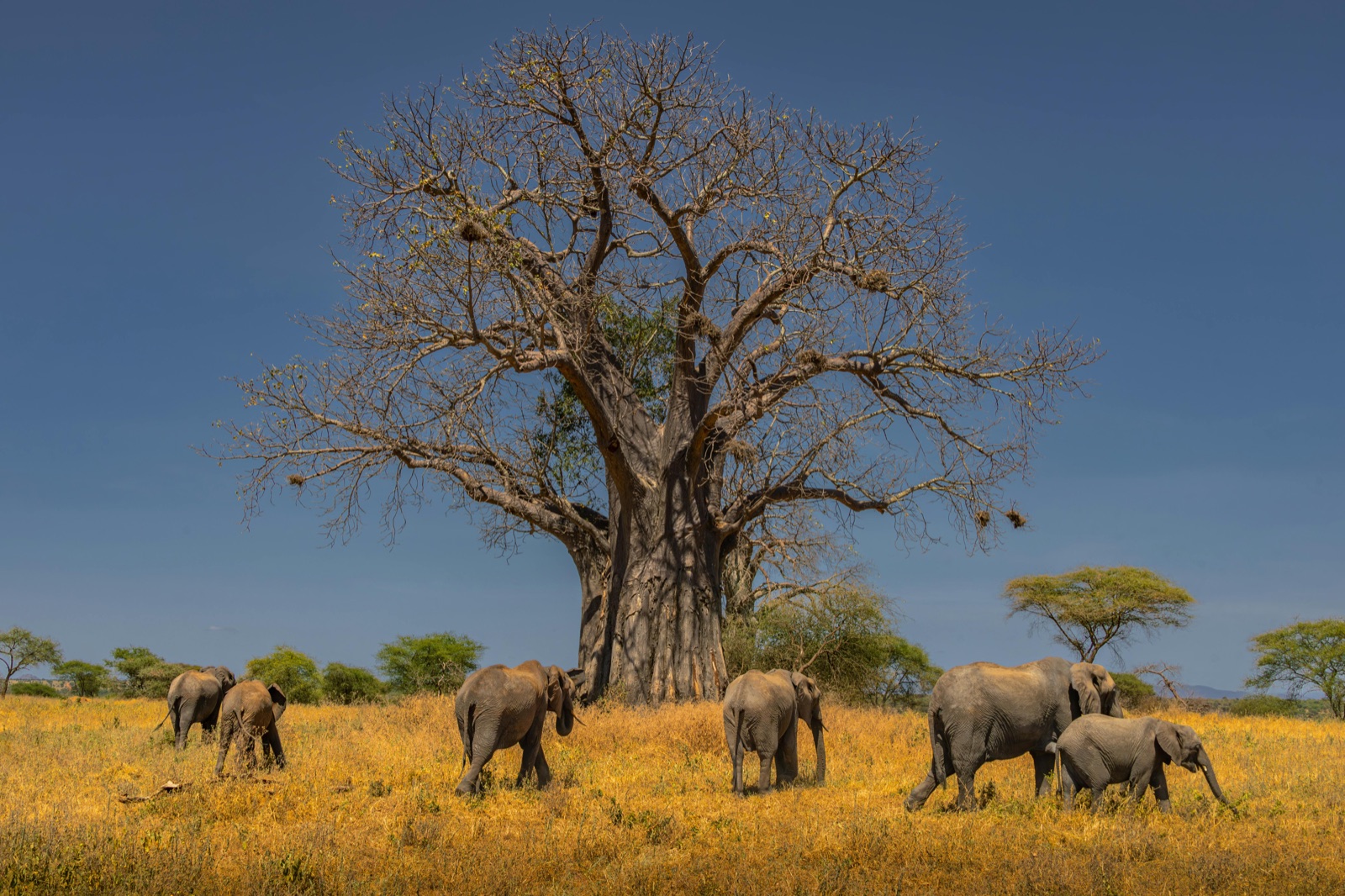
About Tarangire National Park
The Tarangire River is why this park works. From roughly November through April, rain falls across a 20,000 km² territory north and east of the park. Water pools on the Simanjiro Plains. Wildebeest, zebra, and eland spread out across those plains, following the grass flush. The park empties. Most safari brochures describe this backwards, implying animals migrate into Tarangire. They do not. During the rains, they leave. When the dry season arrives around June and the surface water evaporates, the animals contract toward the one thing left. The Tarangire River runs year-round. Everything else has dried up.
The defining dry-season image is elephant on the river. Family groups that have ranged hundreds of kilometres during the wet months return as water fails, and the banks start filling up. Herds of 50, 100, sometimes more, moving to drink, digging in the sandy edges, calves at the centre. The Tarangire Elephant Research Project has tracked these animals individually since 1993, mapping genealogies across hundreds of identified individuals. No current TAWIRI census isolates the elephant count inside the park boundary specifically. The population is measured across the wider range. What the data does confirm: no other park on the northern circuit delivers this density of elephant in one viewable corridor during the dry months.
The baobabs get described as '1,000 years old' on almost every safari website. That figure is plausible. Baobabs are among the longest-lived trees on Earth, and radiocarbon dating of other African populations has confirmed individuals past 1,000 years. But no specific Tarangire tree has been dated. The claim is reasonable. It is not sourced. What is indisputably true: Tarangire has the highest baobab density in Tanzania, and the visual effect of those enormous silver-grey trunks against red-ochre soil is unlike anything else on the northern circuit. Not a subtle difference. A jarring one.
Two species make Tarangire worth combining with the Serengeti rather than using as a transit stop. Fringe-eared oryx, distinguished by black hair tufts at the ear tips, appear on Tarangire's open flats and almost nowhere else on the circuit. Greater kudu, with spiralling horns reaching over a metre, live in the southern Lemiyon woodland. Most itineraries never reach Lemiyon. The rock python uses baobab cavities as shelter and ambush sites, behaviour specific to Tarangire in the field literature and not something you will encounter at Serengeti. And the bird list: 588 species (Avibase 2025), one of the highest counts for any park in Africa, a fact almost no one leading with elephants bothers to mention.
Wildlife in Tarangire
Elephant
The signature species. Multi-generational herds tracked since 1993 by the Tarangire Elephant Research Project, with hundreds of individuals individually identified. Dry season (June-Oct) concentrations along the Tarangire River are unmatched on the northern circuit. Family groups of 50-100+ animals are routine at peak dry season.
Fringe-Eared Oryx
Distinctive subspecies of East African oryx, named for the black tufts at their ear tips. Present in Tarangire year-round in small groups on the open grasslands; reliable on most dry-season game drives. Almost absent from all other northern circuit parks. One of the few species you can only add to your list here.
Rock Python
Documented using hollow baobab trunks as shelter and ambush points. The tree-climbing behaviour associated specifically with Tarangire's baobabs, where pythons coil in cavities or on low branches, is genuinely unusual. Sightings are not routine but not exceptional either, and Tarangire is the park where guides specifically look for them.
Lion
Resident prides hold territories along the Tarangire River corridor and around Silale Swamp. The high prey density during dry season produces active, well-fed prides. Not as numerically dense or as well-studied as the Serengeti Lion Project population, but reliable sightings across a dry-season stay.
Buffalo
Herds of several hundred gather on the river plains in dry season. The concentration dynamics mirror the elephant pattern: dispersed across the wider territory in the wet season, pulled to the river when water fails elsewhere.
Birds (588 species)
588 species recorded (Avibase 2025), one of the highest counts for any single national park in Africa. Key targets: ashy starling (endemic to north-central Tanzania, reliable in the baobab woodland), yellow-collared lovebird, rufous-tailed weaver, Von der Decken's hornbill, martial eagle. The Silale Swamp area produces the highest waterbird diversity, including open-bill storks, saddle-billed storks, and yellow-billed stork in large numbers.
The Mini-Migration: What Most Websites Get Backwards
Every brochure mentions 'the migration.' Almost all of them describe it backwards.
During the wet season (November through April), rain falls across a 20,000 km² territory around the park. Water pools on the Simanjiro Plains to the east, the Maasai steppe to the south, the Manyara Ranch corridor to the north. Grass flushes. Wildebeest, zebra, and eland leave Tarangire and disperse into that wider area to follow it. The park during this period holds its residents, elephants, predators, and oryx, but not the massed migrating grazers.
When the dry season arrives around June, those water sources fail. The Tarangire River, fed by springs in the Ngorongoro highlands, keeps running. Everything else has dried up. The wildebeest and zebra return. The predators follow.
The rains push the animals out. The dry season pulls them in. A visitor who books in November expecting a Serengeti-level show will be disappointed. One who arrives in August knowing what the concentration is, and why, will understand what they are looking at.
Park Zones: Where to Go and When
The northern zone, from the main gate down to the Tarangire River bend, is where most one-day and two-day itineraries stay. Elephant herds concentrate here in the dry season, moving between both banks. Lions follow the elephant movements and are reliably found along this stretch.
Silale Swamp, in the central park, is the best single birding stop in Tarangire. A permanent marsh that holds hippo, crocodile, and large waterbird concentrations year-round, including saddle-billed storks, yellow-billed storks, open-billed storks, and spoonbills in numbers. In dry season the surrounding acacia fringe also pulls lion, buffalo, and elephant. A morning at Silale consistently produces more species than anywhere else in the park.
The southern Lemiyon area is rarely visited. Getting there requires either an extra half-day or an overnight inside the park. What it offers: greater kudu in mixed miombo woodland, a much lower vehicle count, and terrain with a genuinely different character from the baobab plains up north. Guides who know Lemiyon rate it for quality of encounter. Not quantity of animals.
The eastern concession land outside the national park boundary holds Oliver's Camp (&Beyond) and Sanctuary Swala. These properties offer off-road driving and walking safaris, which are not permitted inside the park proper. The concession areas are excellent. They do not reliably deliver the same elephant concentrations as the riverine zone at peak dry season.
Tsetse Flies: An Honest Assessment
Tarangire has a tsetse fly problem that operators mention infrequently. The flies are present in the dense bush and riverine woodland areas throughout the year and are most active in the early morning and late afternoon, which is exactly when game drives run.
Tsetse bites are painful, they draw blood, and they can, in rare cases, transmit sleeping sickness (African trypanosomiasis), though tourist transmission is extremely uncommon. The main practical issue is not health but comfort.
Mitigation is simple and effective: avoid dark blue and black clothing, which tsetse are attracted to; wear light-coloured long sleeves on morning drives; apply DEET-based repellent to exposed skin. Guides carry repellent and can advise on vehicle positioning to avoid the worst concentrations. The tsetse issue is real and not one to ignore, but it is not a reason to skip the park.
Entry Fees (2026)
| Fee Item | Amount | Notes |
|---|---|---|
| Non-resident adult entry (peak, 16 May - 14 Mar) | $82.60 (VAT incl.) | Base $70 + 18% VAT. TANAPA 2023/24 tariff. |
| Non-resident adult entry (low, 15 Mar - 15 May) | $70.80 (VAT incl.) | Base $60 + 18% VAT. |
| Child age 5-15 | $23.60 (VAT incl.) | Both seasons. |
| Under 5 | Free | |
| Vehicle fee (TZ-registered Land Cruiser) | ~TZS 41,300 (~$17-20) | Paid at gate in Tanzanian shillings. |
| VAT | 18% | Applied to all fees at the GePG payment gateway. |
| Payment method | Card only | No cash at any TANAPA gate. Re-verify fees after July 1, 2026. |
Verify current rates at ncaa.go.tz before travel. All fees are included in Jumbo Safaris package prices.
Best Time to Visit Tarangire
| Months | Weather | Wildlife | Crowds |
|---|---|---|---|
| Jun-Jul | Dry season onset. Cool mornings (~14°C), warm afternoons (~27°C). River levels dropping. | Excellent and improving. Migrating herds returning from the Simanjiro Plains. Elephant and buffalo concentrating. Lions active. | Moderate. Less crowded than the Serengeti in peak season. |
| Aug-Oct | Dry, warm, dusty near the river. No rain. Day temperatures reach 30-32°C by October. | Peak. Maximum elephant and buffalo concentration on the river. Predator activity highest. Fringe-eared oryx reliable on open flats. | Moderate-High. Still far lower vehicle density than Serengeti in August. |
| Nov-Dec | Short rains begin (~mid-November). Landscape greens rapidly. | Wildlife beginning to disperse as water returns across the wider range. Migratory birds arriving. Green season photography. Python sightings can increase as vegetation provides cover. | Low. Rates drop at most lodges. |
| Jan-May | Wet season. Long rains (Mar-May) can make some tracks difficult. | Migrating grazers have left the park for the Simanjiro Plains. Resident wildlife (elephant, predators, fringe-eared oryx) stays. Bird diversity peaks with migrants. Empty plains and short queues at the gate. | Very low. Some camps close in April-May. |
Common Questions
What is Tarangire National Park known for?
Tarangire is known for three things that set it apart from the rest of the northern circuit. First, the dry-season elephant concentration: from June through October, the Tarangire River is the last permanent water across a 20,000 km² territory, and elephant herds from across that range contract toward it. Second, its ancient baobabs: the park has the highest density of baobab trees in Tanzania, with trunks up to 10 metres in diameter and ages plausibly over 1,000 years, though no specific tree has been radiocarbon-dated. Third, species you cannot find elsewhere on the northern circuit: fringe-eared oryx, greater kudu in the southern section, and documented rock python in baobab hollows.
When is the best time to visit Tarangire?
June through October for wildlife concentration. August and September are peak: maximum elephant and buffalo density on the river, predators active, fringe-eared oryx reliable on the open flats. June-July is the best balance of wildlife and lower vehicle numbers. November through March is green season, with migratory grazers dispersed across the wider range and resident wildlife still present. Bird diversity peaks in the wet season with the arrival of European and Asian migrants. Avoid April-May in a vehicle-dependent itinerary: the long rains make some tracks difficult and several camps close.
How many elephants are in Tarangire?
No current published TAWIRI census isolates the elephant population inside the Tarangire National Park boundary specifically. The elephants range across a wider territory seasonally, and the population is measured at that level. What is consistent and documented: dry-season concentrations on the Tarangire River regularly produce sightings of multi-generational herds of 50 to several hundred animals in one area. The Tarangire Elephant Research Project has individually identified and tracked hundreds of specific elephants across this range since 1993.
Are there tree-climbing pythons in Tarangire?
Yes. Rock pythons using hollow baobab trunks as shelter and ambush sites is documented behaviour associated specifically with Tarangire. The pythons coil inside or on the exterior of baobab cavities; this is not typical python behaviour elsewhere on the northern circuit. Sightings are not guaranteed on any single game drive, but guides look for them deliberately. Kuro Airstrip and the northern river circuit are the most common areas for sightings. This is a genuine field observation, not a tour operator embellishment.
How many bird species does Tarangire have?
588 species are recorded for Tarangire National Park (Avibase 2025). This figure is significantly higher than the 550 commonly cited on most operator websites. Key species include the ashy starling, endemic to north-central Tanzania and reliable in Tarangire's baobab woodland; yellow-collared lovebird; rufous-tailed weaver; Von der Decken's hornbill; martial eagle. Silale Swamp in the central park is the highest-diversity birding spot, producing large concentrations of waterbirds year-round alongside saddle-billed storks, open-billed storks, and spoonbills.
Is Tarangire worth visiting or just a day stop?
Worth a dedicated stay of two to three nights if you are in Tanzania during the dry season (June-October). Tarangire is not a transit stop on the way to the Serengeti. The dry-season elephant concentration is a different wildlife experience from anything the Serengeti delivers: massed family groups on a single river, undiluted by the vast terrain. One day gives you a good game drive. Two nights gives you Silale Swamp, time on the river at different hours, and a realistic chance of finding lion on a kill or python in a baobab. The Lemiyon area in the south requires a third day and is for guests who specifically want greater kudu and different terrain character.
How far is Tarangire from Arusha?
The main Arusha gate is approximately 118 km from Arusha, about 2 to 2.5 hours by road depending on traffic through Makuyuni. The route is tarmac the entire way. Tarangire is the first park on the standard northern circuit and the closest major park to Arusha by road, which makes it the natural Day 1 destination on most itineraries. The Kuro Airstrip inside the park is served by Coastal Aviation and Auric Air from Arusha (approximately 30-40 minutes flight time).
Can you see the Big Five in Tarangire?
Not reliably. Lion, leopard, elephant, and buffalo are all present and reasonably reliable in the dry season. Rhino are absent from Tarangire; there is no active rhino population here. Tarangire is not a Big Five park in practice, and any operator claiming otherwise is not being honest. What Tarangire offers instead is depth on elephant, genuinely unusual terrain, and species (fringe-eared oryx, greater kudu, rock python) that add to your Tanzania list without being on any Big Five checklist.
Is Tarangire safe from tsetse flies?
Tsetse flies are present in Tarangire, particularly in the dense riverine bush areas, and they bite. The bites are painful but health risk to tourists is extremely low. The main precaution is simple: avoid dark blue or black clothing, which strongly attracts tsetse; wear light-coloured long sleeves; apply DEET repellent to exposed skin. Health transmission risk from tsetse-borne sleeping sickness in tourist areas of northern Tanzania is rare. The flies do not make Tarangire a park to avoid. They are a minor discomfort that good preparation eliminates.
What is the difference between Tarangire and the Serengeti?
They are different parks serving different objectives. The Serengeti offers the Great Migration, 14,763 km² of varied terrain, and the world's most studied lion population. Tarangire offers a more concentrated dry-season experience on a smaller stage, with significantly lower vehicle density than the Serengeti in peak season. The species that Tarangire adds to a northern circuit itinerary, fringe-eared oryx and greater kudu, are absent from the Serengeti entirely. Most northern circuit itineraries include both. If you are choosing between them on a short trip, the Serengeti takes priority. But the two are not alternatives in the same category.
What is the fringe-eared oryx?
The fringe-eared oryx is a subspecies of the East African oryx, distinguished by black tufts of hair at the tips of its ears. It is a large, pale-coloured antelope with long straight horns reaching 75-90 cm. Tarangire and the surrounding territory form one of the most accessible places in the world to see them; they are absent from the Serengeti, Ngorongoro, and Ruaha. Small groups appear on the open grassland areas of the northern park on most dry-season game drives.
Safari Itineraries Including Tarangire