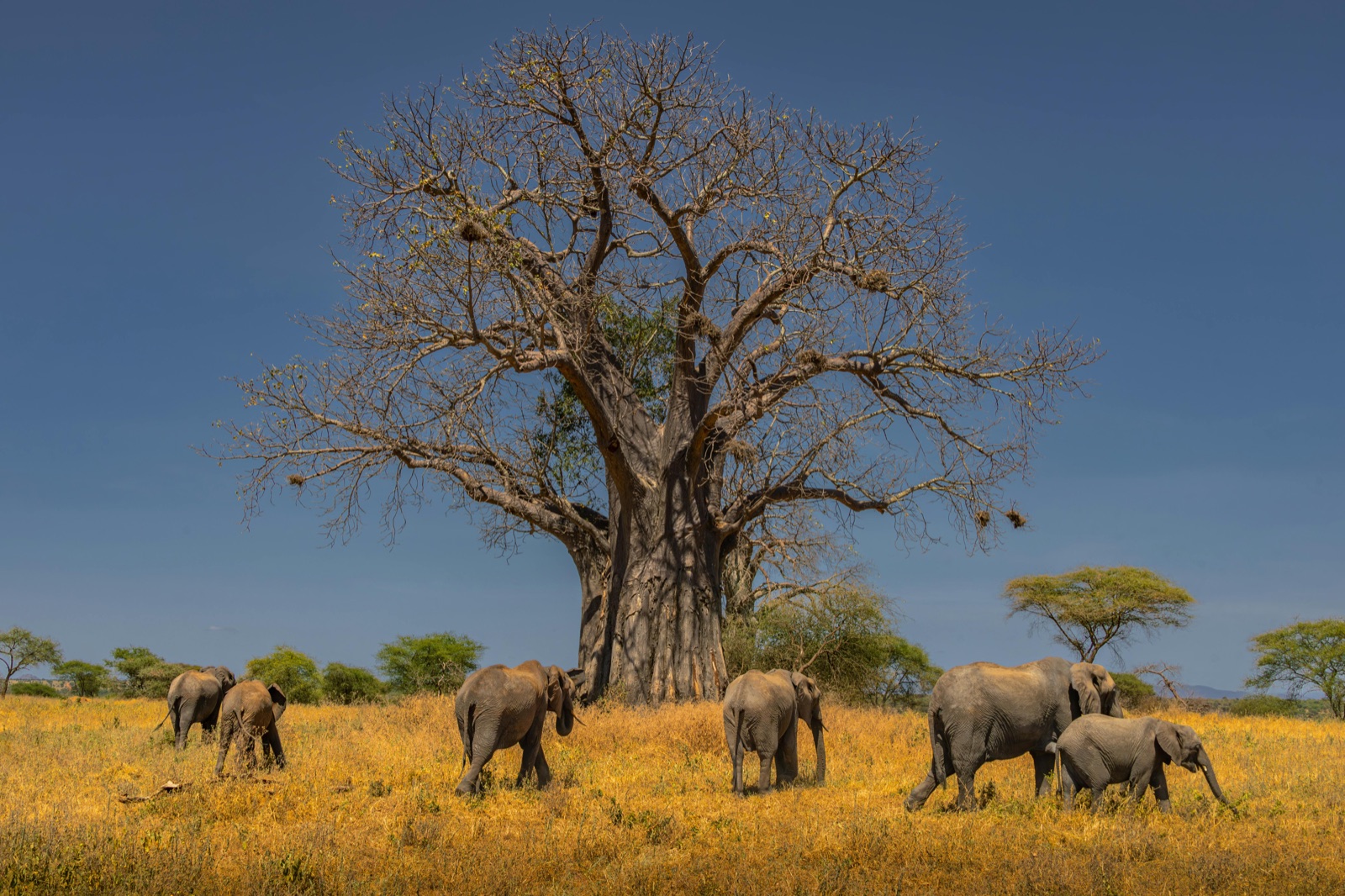
Ruaha National Park
For the safari traveller who has done the migration and now wants the silence.
Plan a Safari HerePark imagery
About Ruaha National Park
Ruaha sits in the south-central highlands of Tanzania, well off the northern circuit that most visitors follow. Getting here requires a flight. Coastal Aviation's daily Dar es Salaam to Msembe service takes about 2.5 hours; from Arusha it's closer to two hours with a stop. The nearest town is Iringa, 112 kilometres from the park boundary. That distance is not incidental. It is the mechanism by which Ruaha stays empty. Around 20,000 visitors per year in a park 40 percent larger than the Serengeti, which sees 350,000.
The Great Ruaha River and its sand tributaries (the Mwagusi and Mdonya) are the ecological spine of the park. In the dry season (June through October), as smaller water sources fail across the park's 20,226 square kilometres, every animal contracts toward the river. Elephants dig in the dry sand for subsurface water, a signature Ruaha image that repeat visitors describe more than any other. A legacy of heavy poaching between 2009 and 2014, when the population crashed from around 30,000 to roughly 8,272, means many of the surviving females are tuskless. The Ruaha-Rungwa ecosystem now holds around 15,000 elephants in recovery, according to the Southern Tanzania Elephant Program's 2021 survey. Buffalo herds here exceed 500 regularly. Prides of 15 to 25 lions, among the largest documented in Africa, hold territories along the riverine strip.
Ruaha is one of three remaining African landscapes with more than 500 adult wild dogs, alongside KAZA (Botswana, Zimbabwe) and the Selous-Niassa corridor to the east. The Ruaha Carnivore Project, founded in 2009 by Dr. Amy Dickman and now operating within Lion Landscapes, tracks 37 documented packs across the broader Ruaha-Rungwa-Katavi landscape. Wild dog sightings are not guaranteed, but the June-July denning season near Mwagusi is the most predictable window. Pack hunt success rates run around 80 percent, compared to the lion's 25-30. Watching a pack hunt on open ground is among the most efficient and fastest predator events in Africa. Most guests who see it rate it above any river crossing they have witnessed.
The landscape is where Ruaha diverges most sharply from northern Tanzania. The park sits at the convergence of East African and Southern African biomes, which means it holds species that simply do not exist in the Serengeti or Ngorongoro. Greater and lesser kudu appear together. Sable antelope and roan antelope are resident. The Ruaha red-billed hornbill is endemic to this park. The bird list exceeds 570 species, including migrants from Europe and Asia in the green season. Guides here regularly check the scarred hollows of baobab trunks for leopards taking refuge from the afternoon heat, a Ruaha-specific behaviour that would puzzle a guide who has worked only in the north.
Walking safaris are freely permitted throughout the park. Operators including Jongomero and Kichaka Expeditions run multi-day fly-camping routes into the remote eastern sections where no vehicle tracks exist. This is something the Serengeti cannot offer. In the core areas, the experience is still vehicle-based, but the absence of track restrictions and the low vehicle density means the drive itself feels qualitatively different. You do not queue. You do not share a sighting with eight other Land Cruisers. The animal does not ignore you because it has been desensitised to vehicles. In Ruaha, some animals still react to your presence, which is actually the more honest wildlife encounter.
Wildlife in Ruaha
African Wild Dog
One of three African landscapes with 500+ adult wild dogs (WCS Tanzania). 37 packs documented in the Ruaha-Rungwa ecosystem. June-July denning near Mwagusi is the most predictable sighting window. Hunt success around 80%.
Lion
Around 10% of Africa's total lion population. Prides of 15-25 individuals, among the largest documented anywhere. Territories run along the Great Ruaha River and the Mwagusi sand river.
Elephant
Ruaha-Rungwa ecosystem holds roughly 15,000, recovering from a poaching crash that hit 8,272 in 2014. Many tuskless females as a legacy. Herds of several hundred concentrate on the river in the dry season. Elephants digging for subsurface water in dry sand riverbeds is the signature Ruaha image.
Greater Kudu
Absent from northern Tanzania. Males carry spiralling horns reaching over a metre in length. Present year-round in the mixed woodland and miombo forest zones.
Sable Antelope
Scimitar-horned, jet-black males. Absent from the northern circuit. Reliable in the park's open grassland areas during the dry season.
Ruaha Red-Billed Hornbill
Endemic to Ruaha National Park, found nowhere else. One of over 570 bird species recorded here, including European and Asian migrants in the green season.
Walking Safaris
Walking safaris in Ruaha operate under a different set of rules from the northern circuit. The park permits multi-day foot safaris, including remote fly-camping in the eastern sections where no vehicle tracks exist. Operators like Kichaka Expeditions (three tents, specialist guide Andrew 'Moli' Molinaro) and Jongomero have built their reputations specifically on foot-based wildlife encounters.
On a walking safari, the guides work at a different scale. They read tracks in sand riverbeds, identify kills from vulture behaviour half a kilometre away, and use the wind and terrain to approach animals on foot. The elephant's reaction to a walking party is not the same as its reaction to a Land Cruiser. Some guides argue the walking encounter is the more honest wildlife experience.
Walking safaris are not suitable for families with young children and require reasonable physical fitness. Half-day walks from a vehicle-based camp are available at most properties, including Mwagusi and Jongomero. Full multi-day routes require advance booking and are best discussed directly when planning the trip.
Camps: Current Status
Camp selection in Ruaha matters more than in the northern circuit because the park is vast and properties are far apart. Your camp's location determines which section of the park you access most easily.
Jongomero Camp is eight luxury tents in the remote south, on a private concession. Now operated by the LABA Hotel Group after renovation. Rates run around $997 per person per night in 2026/27. Operates June 1 through March 1. The southern position gives access to terrain with a Southern African ecological character: greater kudu, sable, and different predator dynamics from the northern riverine areas.
Mwagusi Safari Camp, on the Mwagusi sand river, is the camp safari specialists consistently name first. Owner-run by Chris Fox. The wild dog packs that den near Mwagusi in June-July are the reason. Widely called the best location in the park.
Kokoko Camp (Asilia) replaced Kwihala, which has permanently closed. Many pages still list Kwihala. Do not be confused. Kokoko occupies a similar position with updated facilities.
Jabali Ridge (Asilia) opened in 2017 with eight suites on a kopje, infinity pool, and a spa. Positioned for those who want luxury infrastructure alongside remote wildlife.
Ruaha River Lodge (Foxes Safari Camps) is the oldest property in the park and the only one that operates year-round. Stone-and-thatch bandas on the Great Ruaha River. The most economical option, and the only choice if you are travelling in the April-May window.
Kigelia Ruaha (Nomad Tanzania), Mdonya Old River Camp, Ikuka Safari Camp, and Kichaka Expeditions complete the serious options.
Best Time to Visit Ruaha
| Months | Weather | Wildlife | Crowds |
|---|---|---|---|
| Jun-Aug | Dry, warm days, cold nights (10°C at times). Single rainy season means drier than northern circuit equivalents. | Excellent. Wildlife concentrating on rivers. Wild dog denning: the most predictable sighting window of the year. | Low |
| Sep-Oct | Dry, hot (30-35°C midday). Elephants digging for water in sand riverbeds. | Peak dry-season concentration. Elephant herds at maximum. Buffalo herds 500+. Predator action highest. | Low-Moderate |
| Nov-Dec | Rains begin around mid-December. Lush and green. Birding peaks with European and Asian migrants arriving. | Wildlife disperses as water sources return. Wild dog pups emerging with packs. Photography conditions excellent. | Very low |
| Jan-Feb | Green season. Hot and humid. Rains intensify through February. | Dispersed but present. Breeding season for many species. Exceptional birding. | Very low. Discounted rates at most camps. |
| Mar-May | Ruaha has one long rainy season (unlike the north's two). March-April is the wettest, with ~250mm in April. Coastal Aviation suspends Ruaha flights mid-March to end of May. | Most camps closed. Ruaha River Lodge remains open year-round and offers significant discounts. Expert Africa notes April-May as a quietly excellent window for those who self-drive from Iringa: clear skies after morning rain, lush landscapes, virtually zero other visitors. | Closed season for most operators. Ruaha River Lodge open. |
Common Questions
What makes Ruaha National Park unique?
Three things set Ruaha apart from every other Tanzania park. First, it sits at the convergence of East African and Southern African ecosystems, which means it holds species absent from the northern circuit entirely: greater kudu, lesser kudu, sable antelope, roan antelope, and the endemic Ruaha red-billed hornbill found nowhere else on Earth. Second, it is one of only three African landscapes with more than 500 adult wild dogs (with KAZA and Selous-Niassa), and the packs here are actively tracked. Third, walking safaris are freely permitted, including multi-day routes into remote areas with no vehicle tracks. The Serengeti prohibits walking in the core zone entirely.
Is Ruaha worth visiting? How does it compare to the Serengeti?
They are not comparable in a straightforward way. The Serengeti has the Great Migration, 350,000 annual visitors, extensive infrastructure, and the largest wildlife spectacle in Africa. Ruaha has 20,000 annual visitors, a park 40% larger, no hot-air balloons, and long drives without seeing another vehicle. The wildlife encounters at Ruaha feel different from the northern circuit because the animals are less habituated to vehicles. Many repeat safari visitors say Ruaha is the park that made their previous trips feel crowded. If this is your first Tanzania safari and you want the migration, start with the northern circuit. If you have done the northern circuit and want something else, Ruaha is the right next step.
Are there cheetahs in Ruaha?
Yes, cheetahs are present in Ruaha but sightings are less consistent than in the Serengeti or Ndutu. The open grassland areas offer sprint-hunting conditions, but the mixed woodland that covers much of the park is not ideal cheetah habitat. Sightings are possible, particularly in the open plains near the Mwagusi area, but cheetah is not a reliable Ruaha headline species. Wild dog, lion, and elephant are the reliable targets.
How do you get to Ruaha National Park?
The standard route is a flight to Msembe Airstrip inside the park. Coastal Aviation operates a daily service from Dar es Salaam (approximately 2.5 hours, from around $430 one-way). Auric Air flies the Serengeti-Ruaha route three times a week (Monday, Thursday, Saturday), useful for combining northern and southern circuits on one trip. Coastal Aviation suspends Ruaha flights mid-March to end of May due to the long rains. Self-drive from Iringa (112 km, about three hours on rough dirt roads) is possible with a 4WD, and Ruaha River Lodge is the only camp that caters specifically to self-drive guests.
How many days do I need in Ruaha?
Three full days is the minimum for a meaningful visit. Five is better. Ruaha rewards longer stays in fewer camps more than the multi-camp model that suits Luangwa or a quick Serengeti circuit. Wild dog in particular requires time: packs are not visible every day, and a guide working the radio network over multiple days improves your odds significantly. The best Ruaha trips tend to base at one or two camps, explore the same areas repeatedly, and leave knowing specific animals. Three-day visits tend to leave guests wishing they had stayed longer.
Are wild dogs guaranteed in Ruaha?
No. Wild dog sightings are never guaranteed anywhere in Africa, and experienced visitors report wildly different outcomes: some see packs on day one, others complete seven-day trips without a sighting. What Ruaha offers is the highest probability in East Africa. The June-July denning season, when packs return daily to a fixed den site, is the most predictable window. Guides track pack locations via the radio network with researchers from the Ruaha Carnivore Project. Minimum three full days strongly improves the odds.
Can you combine Ruaha with the northern circuit?
Yes. Auric Air's three-times-weekly Serengeti to Ruaha flight is the direct connection, making a northern-then-southern circuit possible without routing through Dar es Salaam. Allow at least 12 days total to do both circuits justice. A Ruaha and Zanzibar combination is also popular: fly Dar es Salaam to Ruaha for 4-5 nights, then Ruaha to Zanzibar via Dar or direct with Coastal Aviation. Contact us with your dates and we will build the routing.
What is the best lodge in Ruaha?
Safari specialists consistently name Mwagusi Safari Camp first for overall experience and location. Jongomero is the top luxury option, with eight tents in a private concession in the remote south at around $997 per person per night. Jabali Ridge (Asilia) has the best infrastructure for guests who want hotel-standard amenities in the bush. Ruaha River Lodge (Foxes) is the most economical and the only property open year-round. Kichaka Expeditions is the right choice if walking safaris are the priority. Note: Kwihala Camp has permanently closed and has been replaced by Kokoko Camp (Asilia). Many websites still list Kwihala incorrectly.
Safari Itineraries Including Ruaha