Lake Manyara National Park
A flooding alkaline lake, 624 bird species, and one of the most misquoted parks in Africa.
Plan a Safari Here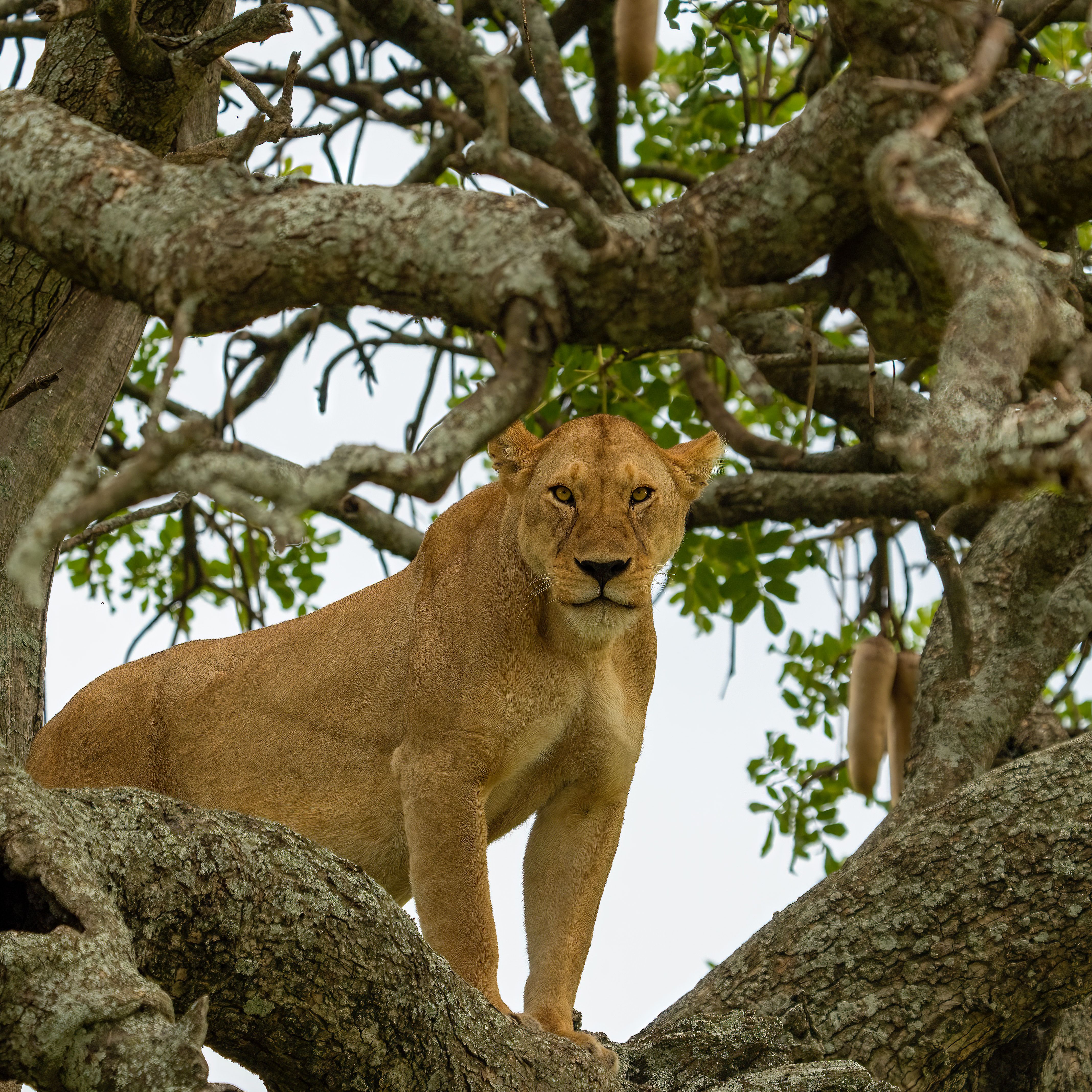
About Lake Manyara National Park
The Rift Valley escarpment rises 600 metres above Lake Manyara in a near-vertical wall, and it is not a backdrop. It is what makes the park work. Springs from the highland forest above push water down through the rock and emerge at the cliff base as a belt of artesian flow, feeding a strip of groundwater forest that has no business growing at this altitude without reliable rainfall. It grows from below. Figs, mahogany, and sausage trees form a canopy over blue monkeys and olive baboon troops numbering in the hundreds, with a lower storey that provides cover for elephant, buffalo, and leopard. You drive through this forest when you enter the park, before the vegetation opens onto the lakeshore. Most visitors treat it as a warm-up. It is not.
The tree-climbing lion is on every Lake Manyara page. The honest position: sightings are not reliable. The behaviour is real. Certain prides do rest in fever acacias and sycamore figs, particularly during the heat of the day. But in 2024-2025, those specific prides are not consistently traceable, and the frequency has declined from what earlier decades of field notes reported. It is also not unique to Manyara. Ishasha in Uganda's Queen Elizabeth National Park is now arguably more consistent for tree-climbing lions. If you see them here, you will remember it. If you do not, that is the more likely outcome, and any operator presenting tree-climbing lions as the reason to visit is not setting honest expectations.
Since approximately 2020, Lake Manyara's water level has been rising. The cause is a combination of above-average rainfall in the highland catchment and the volcanic groundwater system beneath the Rift Valley floor pushing more water into the basin than it is losing to evaporation. The advancing lake has flooded the fever tree woodland at the southern end of the terrestrial strip. The trees have died standing. What remains is a Ghost Forest: white-grey skeleton trunks in shallow alkaline water, the dead canopy open against the sky, flamingos on the lake surface beyond. This is one of the most photogenic locations in northern Tanzania right now. It did not exist before 2020. Operators not mentioning it are writing from templates last updated years ago.
Ernest Hemingway visited in 1933 and described Lake Manyara in Green Hills of Africa as 'the loveliest I had seen in Africa.' That is the actual quote. Many lodges and safari websites attribute to him the phrase 'Africa's Eden.' No source exists for that attribution. It is a marketing invention that has circulated without anyone checking. The real quote is a better compliment: Hemingway was not given to easy sentimentality about places, and he used Manyara as a benchmark. What he saw was the escarpment, the forest, the lake, and the flamingos. The Ghost Forest was not there. He never described it.
Wildlife in Lake Manyara
Birds (624 species)
624-626 species recorded (Avibase 2025). The most commonly cited figure of 400+ on competitor sites is significantly low. Key targets: lesser flamingo and greater flamingo on the lake surface; pink-backed pelican in large breeding colonies; African fish eagle; saddle-billed stork; grey crowned crane. The groundwater forest produces a different set: Schalow's turaco, trumpeter hornbill, brown-headed parrot. The Manyara bird list is one of the highest of any sub-2,000 km² park in Africa.
Flamingo
Lesser flamingo is the primary species, with greater flamingo also present. Manyara is an alkaline lake, and flamingo numbers track the cyanobacteria bloom cycle that provides their food. Highly variable. Years with optimal water levels and salinity produce tens of thousands of birds along the southern and eastern shoreline. Years without those conditions may produce hundreds or none. The Ghost Forest area on the southern shore is currently one of the most photogenic locations for flamingo photography when birds are present, with skeleton trees framing the pink lake surface.
Hippo
Permanent pools in the river outlets and along the lakeshore provide reliable hippo sightings year-round. The Maji Moto Hot Springs area in the south of the park holds a hippo pool alongside geothermal vents that produce warm, sulphurous water. This is a specific, unusual feature that most guides include on a full-day circuit.
Elephant
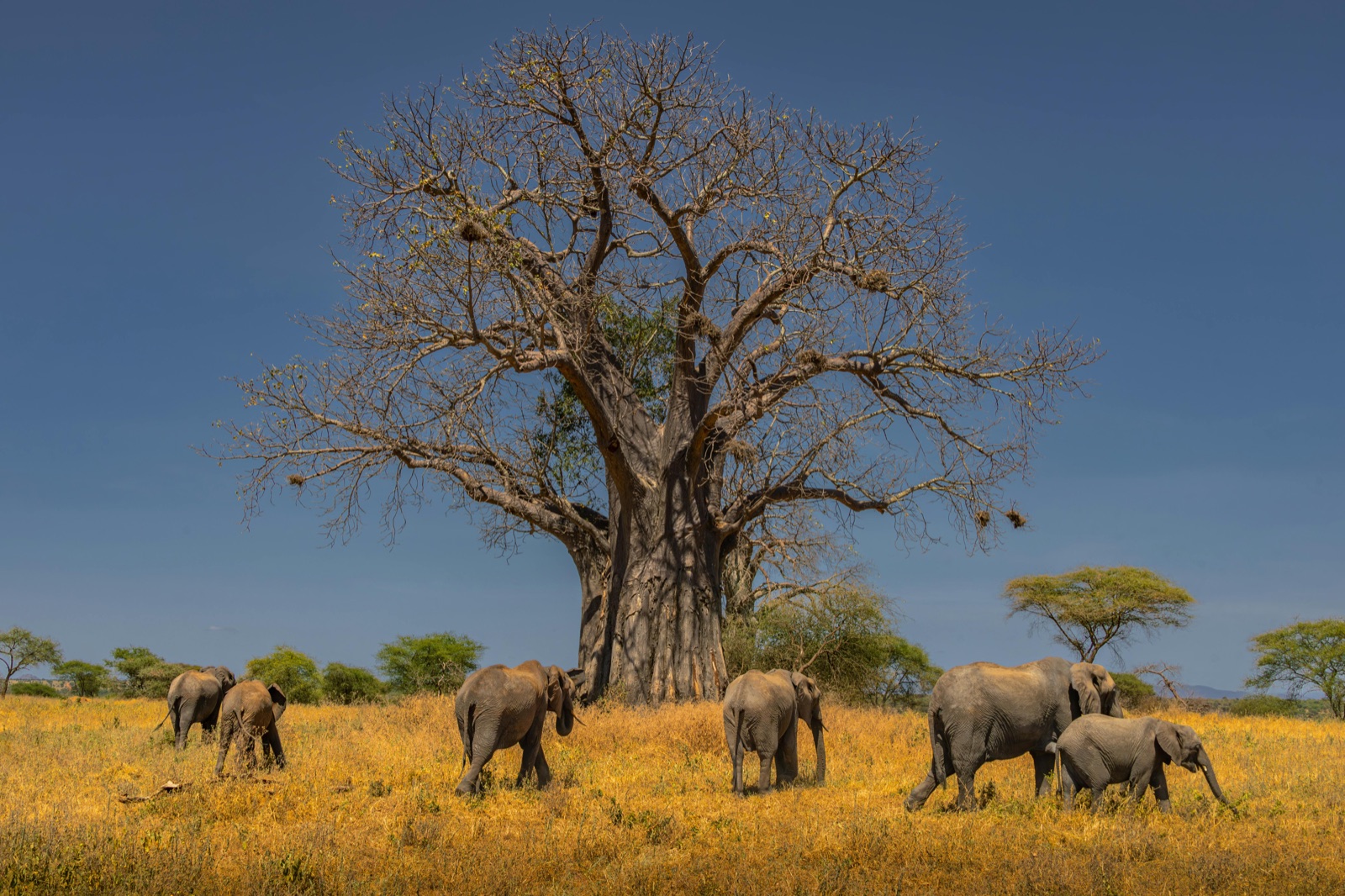
Resident elephant move between the groundwater forest and the open lakeshore grasslands. Family groups are encountered in the forest section near the park entrance and along the escarpment base. Numbers are lower than Tarangire, but the groundwater forest encounters are visually very different from open-country sightings.
Blue Monkey and Olive Baboon
The groundwater forest is the most reliable location in northern Tanzania to see blue monkeys alongside olive baboons in the same habitat. Baboon troops of 50-100 animals are common near the forest entrance. Blue monkeys move through the upper canopy. Both species are present year-round.
Lion (tree-climbing, variable)
Tree-climbing behaviour is documented in certain Manyara prides and is real. As of 2024-2025, sightings are not reliably predictable. The behaviour is linked to specific prides and appears to have declined from the frequency reported in earlier decades. Do not structure a visit around this as the primary objective. If lions are seen in trees, it is a genuine bonus. If not, the park has more than enough other content to justify the day.
The Ghost Forest
Since approximately 2020, the southern end of Lake Manyara's terrestrial strip has been changing in a way that has not been widely communicated in safari marketing.
The lake's water level has been rising. The cause is a combination of increased rainfall in the highland catchment and the volcanic groundwater system beneath the Rift Valley floor pushing more water into the basin than it is losing to evaporation. The advancing alkaline water has flooded a zone of fever acacia woodland at the lake's edge.
The fever trees have died standing. White-grey skeleton trunks, root systems submerged, in shallow alkaline water with the open lake beyond. In low morning light, the scene is unlike anything else in northern Tanzania.
This did not exist before 2020. Operator pages, lodge websites, and booking platforms describe a Lake Manyara that predates it. Guides who visit regularly know about the Ghost Forest. Guests arrive having read descriptions of a park that no longer looks the same as when those descriptions were written.
For photographers, the combination of skeleton trees, alkaline water, and flamingo in the foreground produces images that have no equivalent at any other park on the northern circuit.
Canopy Walkway and Escarpment Viewpoints
Lake Manyara has a canopy walkway inside the groundwater forest. The walkway, suspended in the forest canopy at approximately 3.5 metres above the ground, allows visitors to move through the upper level of the forest at eye level with the birds and primates that work the canopy. Schalow's turaco and blue monkey sightings from the walkway are among the most intimate wildlife encounters available in a park that otherwise requires you to stay in a vehicle.
The walkway has had intermittent operational status. Before including it in a Manyara day, confirm with the guide that it is currently accessible. When it is operating, a morning on the walkway before the midday ground drive is the recommended sequence: the forest primates are active in the early hours, and the walkway experience is genuinely different from the vehicle-based circuit.
The top of the Rift Valley escarpment is visible throughout the park. The escarpment itself is not accessible from inside the park, but the town of Mto wa Mbu at the base of the escarpment, just outside the gate, sits at the start of the road that climbs to the rim at Karatu and continues to Ngorongoro. The view of the lake from above, accessible from the escarpment road, is frequently cited by guides as a better overview than anything available from inside the park itself.
The Honest Case For Lake Manyara
Lake Manyara is consistently used as a half-day stop on the drive between Arusha and Ngorongoro. Often the first park visitors see. A warm-up. This is not wrong, but it undersells the park's strongest assets.
A half-day produces a groundwater forest drive, a lakeshore circuit, and reasonable odds of elephant, hippo, flamingo (if conditions are right), and baboon. It does not produce tree-climbing lions reliably, and it does not reach the Ghost Forest or the Maji Moto Hot Springs in the south, both of which require a full-day circuit.
For a first-time northern circuit traveller, a half-day stop on a Ngorongoro-Serengeti itinerary is appropriate, provided expectations are set correctly. This is not a big-game park. It is one of Africa's premier birding parks with an unusually varied habitat in a compact area. For a bird-focused traveller or a photographer specifically after the Ghost Forest, a full day makes sense.
The repeat visitor criticism is consistent: the park is short. Most guests feel they have seen the main circuit in four to five hours. That is accurate. The terrestrial area is genuinely compact. The depth is in specific bird species, the forest walk, the southern lake, not in scale.
Entry Fees (2026)
| Fee Item | Amount | Notes |
|---|---|---|
| Non-resident adult entry (peak, 16 May - 14 Mar) | $82.60 (VAT incl.) | Base $70 + 18% VAT. TANAPA 2023/24 tariff. |
| Non-resident adult entry (low, 15 Mar - 15 May) | $70.80 (VAT incl.) | Base $60 + 18% VAT. |
| Child age 5-15 | $23.60 (VAT incl.) | Both seasons. |
| Under 5 | Free | |
| Vehicle fee (TZ-registered Land Cruiser) | ~TZS 41,300 (~$17-20) | Paid at gate in Tanzanian shillings. |
| Canopy Walkway | USD 20 per person | Operated inside the park. Check current availability; operational status has been intermittent. |
| VAT | 18% | Applied to all fees at the GePG payment gateway. |
| Payment method | Card only | No cash at any TANAPA gate. Re-verify fees after July 1, 2026. |
Verify current rates at ncaa.go.tz before travel. All fees are included in Jumbo Safaris package prices.
Best Time to Visit Lake Manyara
| Months | Weather | Wildlife | Crowds |
|---|---|---|---|
| Jun-Oct | Dry season. Cool, clear days. Escarpment mist common in the morning. | Best for land wildlife: elephant in the forest, hippo, lion, buffalo. Tree-climbing lion sightings most often reported in hot dry-season afternoons. Bird diversity steady year-round. | Moderate. Higher than Tarangire, lower than Serengeti. |
| Nov-Mar | Short rains Nov-Dec, then a drier interlude Jan-Feb, then long rains approach. | Bird diversity peaks with migrants. Flamingo numbers most likely to be high if water and salinity conditions are right. Green season photography. Ghost Forest most dramatic against a stormy sky. | Low-Moderate. Good availability. |
| Apr-May | Long rains. Some tracks can become muddy and impassable. | Lush and green, full bird diversity, but reduced access to some areas. Flamingo numbers variable. | Very low. |
Common Questions
What is Lake Manyara National Park famous for?
Historically, tree-climbing lions. In practice, as of 2024-2025, the park's most significant and undermarketed assets are its birds (624-626 species, one of the highest counts of any enclosed park in Africa), its groundwater forest fed by springs from the Rift Valley escarpment, and the Ghost Forest, a stretch of flooded fever tree woodland on the advancing lakeshore created since approximately 2020. The tree-climbing lion behaviour is real but sightings are no longer reliably predictable.
Do lions really climb trees in Lake Manyara?
Yes, but less predictably than marketing suggests. Certain Manyara lion prides do rest in trees, and this is documented behaviour going back decades. As of 2024-2025, sightings are variable and not reliable enough to structure a visit around. The behaviour is also not unique to Manyara: Ishasha in Uganda's Queen Elizabeth National Park is now arguably more consistent for tree-climbing lion sightings. If you see lions in trees at Manyara, it is a genuine experience. If you do not, the park has bird diversity, a groundwater forest, hippos, and the Ghost Forest to justify the day.
Did Hemingway really call Lake Manyara 'Africa's Eden'?
No. This phrase does not appear in Hemingway's writing. The actual quote, from Green Hills of Africa (1935), is that Manyara was 'the loveliest I had seen in Africa.' 'Africa's Eden' is a marketing invention that has circulated across safari operator websites without a primary source. The real quote is a meaningful compliment from a writer not given to easy sentimentality. The invented quote is not, and any operator using it either has not checked or does not care.
How many bird species are in Lake Manyara?
624-626 species are recorded (Avibase 2025). Most operator websites cite '400+', which significantly understates the count. The park's bird diversity comes from the layering of distinct habitats in a small area: groundwater forest, acacia woodland, open lakeshore grassland, alkaline lake, and the escarpment edge. Key species include lesser flamingo, pink-backed pelican, African fish eagle, grey crowned crane, Schalow's turaco, and saddle-billed stork. This is one of the highest bird counts for any enclosed park of this size in Africa.
What is the Ghost Forest at Lake Manyara?
The Ghost Forest is a stretch of fever acacia woodland on the southern lakeshore that has been killed by the advancing water level of Lake Manyara since approximately 2020. The rising alkaline water flooded the root systems of the fever trees, killing them and leaving white-grey skeleton trunks standing in the lake. Bare tree skeletons in shallow water, with the open lake and often flamingos behind. It is a genuinely unusual photographic subject with no equivalent on the northern circuit.
Are flamingos reliable at Lake Manyara?
No. Flamingo numbers at Manyara are highly variable and track the cyanobacteria bloom in the alkaline lake, which is the birds' primary food source. In years with optimal water level and salinity, tens of thousands of lesser flamingos gather along the southern and eastern shoreline. In years without those conditions, numbers may be in the hundreds or absent. Planning a visit specifically around flamingos at Manyara is not advisable. The Ngorongoro Crater floor's Lake Magadi is a more predictable option, though it is also variable.
How far is Lake Manyara from Arusha?
The park entrance is approximately 125 km from Arusha, about 2 to 2.5 hours by road. The route runs south from Arusha through Makuyuni and then descends the Rift Valley escarpment into Mto wa Mbu, the town immediately adjacent to the park gate. Lake Manyara Airstrip, 1 km from the gate, is served by Coastal Aviation, Auric Air, and Air Excel from Arusha (approximately 20-30 minutes flight time). The airstrip is the standard arrival point for guests continuing to Ngorongoro and the Serengeti by charter flight.
Is Lake Manyara worth visiting?
Yes, on its own terms. Lake Manyara is not a big-game park. It is a compact, habitat-diverse park with one of Africa's highest bird species counts, a groundwater forest unlike anything else on the northern circuit, reliable hippo, elephant, and baboon, and the Ghost Forest, which is a 2024 visual asset no competitor is talking about. A half-day stop as part of a Ngorongoro-Serengeti circuit is appropriate for most first-time travellers. For birders or photographers, a full day is worth it. Do not come expecting reliable tree-climbing lion sightings; expect everything else the park actually delivers.
What is the canopy walkway at Lake Manyara?
A suspended walkway in the groundwater forest at approximately 3.5 metres above ground level, allowing visitors to move through the forest canopy at primate and bird height. Blue monkey and Schalow's turaco sightings from the walkway are more intimate than any vehicle-based encounter in the same habitat. The walkway has had intermittent operational availability. Confirm with your guide before the day that it is currently accessible. When operating, a morning on the walkway before the midday lakeshore circuit is the recommended sequence.
How does Lake Manyara compare to Tarangire?
They are adjacent parks with very different characters. Tarangire is large, dry-season wildlife-dense, and built around its elephant concentration. Lake Manyara is compact, habitat-diverse, and built around birds, forest encounters, and lakeshore scenery. Most northern circuit itineraries include both: Tarangire first (or last) for game viewing, Manyara as a shorter stop on the approach to Ngorongoro. Neither is a substitute for the other. If you must choose one, Tarangire delivers more conventional safari wildlife in the dry season. If birding or forest habitats are the priority, Manyara is the right call.
Can you see the Big Five in Lake Manyara?
No. Buffalo are present in the park but not in reliable large numbers. Lion are present. Leopard are present but rarely seen. Elephant are reliable in the groundwater forest. Rhino are absent. Lake Manyara is not promoted as a Big Five park by honest operators, and any claim to the contrary is misleading. The park's strength is species diversity of a different kind: bird diversity, primate encounters in the forest, and an unusually compact combination of habitats that you cannot find in a single day anywhere else on the northern circuit.
Safari Itineraries Including Lake Manyara