Tanzania Safari in January
The herds arrived on the southern plains in December. By January they are settled around Lake Ndutu, Lake Masek, and Hidden Valley, and the births begin. Scattered at first, then rising sharply through the month toward the late-January peak. This is the start of the most underrated stretch of the Tanzania safari calendar: calving drama at prices 30 to 40 percent below the July peak, with camps you can still actually book. One date matters more than people realise. A traveller arriving January 20 sees a different trip than one arriving January 1, because the birth rate climbs every week.
Plan a January Safari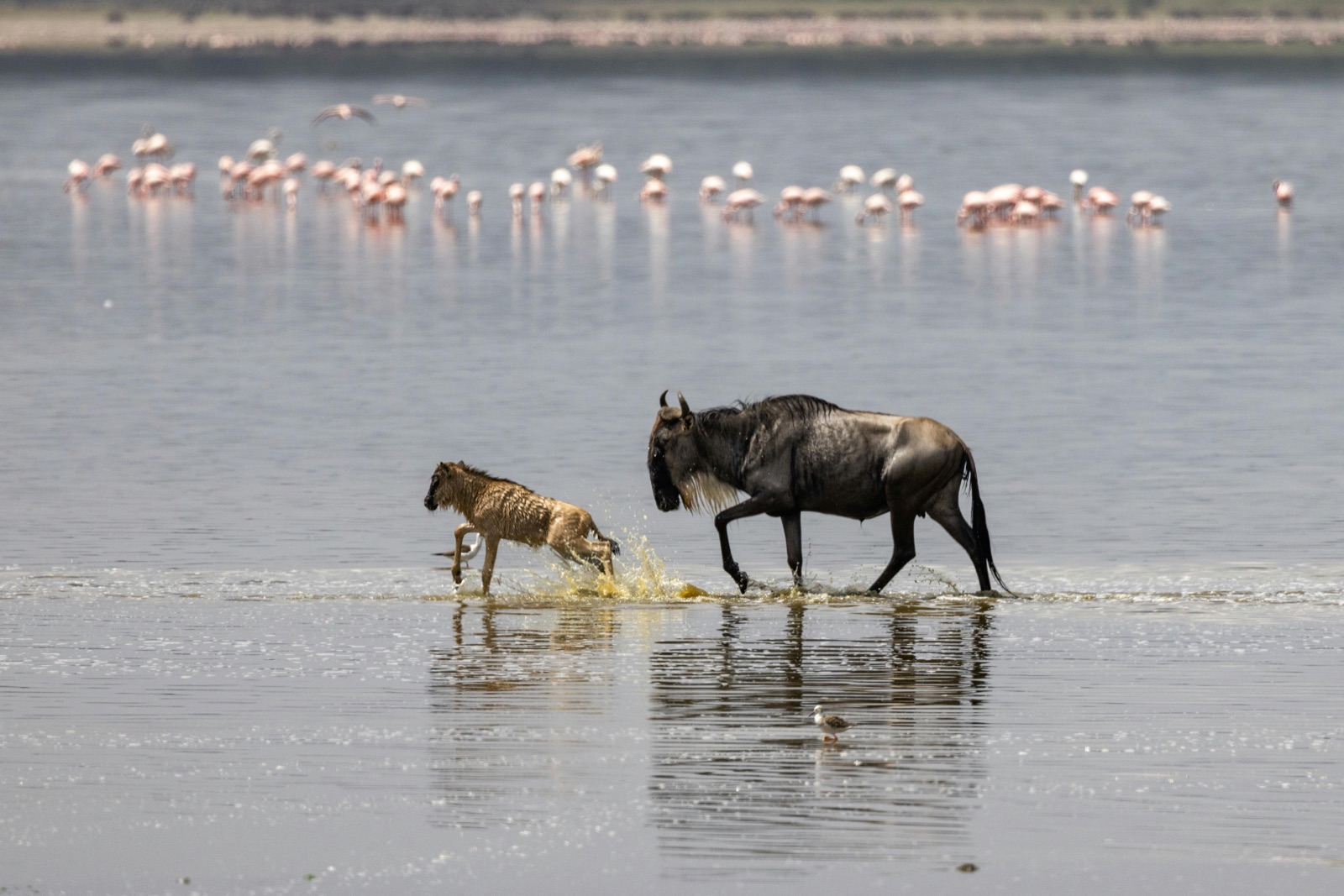
Wildlife Conditions in January by Park
Ndutu / Southern Serengeti
ExcellentThe migration herds are massed on the short-grass plains with births increasing daily. Because Ndutu sits inside the Ngorongoro Conservation Area rather than the national park, off-road driving is legal, and your guide can position at a birth or a hunt instead of watching from the track. Mobile camps fill early. Book 6 to 9 months out.
Ngorongoro Crater
ExcellentDense resident game year-round, with calving happening inside the caldera too. Black rhino on the crater floor, flamingos at Lake Magadi, and migrant birds everywhere. The floor is busy in January. Descend at gate-open to beat the queue.
Central Serengeti (Seronera)
GoodResident lion, leopard, and cheetah are reliable as always, and the southern crowds leave Seronera comparatively quiet. A good pairing with Ndutu if you want big cats without the calving traffic.
Lake Manyara
GoodHippo, elephant, buffalo, and baboon troops, with flamingos and migrant birds at the lake. Tree-climbing lions possible. The northern section gets busy by mid-morning.
Tarangire National Park
FairThe dry-season elephant concentrations dispersed with the rains. Elephants are still present and the birding is good, but January is not Tarangire's month. Save it for June through October.
Week-by-Week: January in the Field
| Week | What's Happening | Best Location |
|---|---|---|
| January 1-7 | Herds settled on the southern plains, births increasing daily, predators very active. The festive crowds clear out after New Year and rates drop within the week. | Ndutu / Hidden Valley |
| January 8-14 | Birth rate rising sharply. Herd density builds across the Ndutu plains with noticeably fewer vehicles than February will bring. | Ndutu plains |
| January 15-21 | The peak calving window opens around mid-month. Thousands of births per day at the height, and every predator in the ecosystem knows it. | Ndutu / Lake Masek shores |
| January 22-31 | Deep in peak calving. Herds move slowly and spread west toward Kusini. This is the strongest week of the month and the bridge into February's peak. | Ndutu, west toward Kusini |
Weather in January by Location
| Location | Temperature | Rainfall | Notes |
|---|---|---|---|
| Arusha | 10°C morning / 29°C afternoon | ~58mm over ~11 days | Short rains tailing off. Sunny mornings, occasional afternoon storms. |
| Central Serengeti (Seronera) | 15°C morning / 28°C afternoon | ~81mm over ~13 days | Green landscape, scattered showers, long grass in the central valleys |
| Ngorongoro Crater Rim | 12-16°C dawn / 28°C midday | ~81mm over ~15 days | Afternoon cloud builds. Rim roads can be muddy after storms. |
| Zanzibar | 24°C night / 32°C day | ~58mm over ~10 days | Mostly sunny, rain falls overnight. North-coast seas can be rough. |
Early January or Late January: It Matters More Than the Guidebooks Say
Calving is not a switch that flips on January 1. Births scatter through late December, ramp through the first half of January, and hit the peak pulse from roughly mid-month into mid-February. A January 5 arrival sees herds, predators, and the first newborns. A January 22 arrival sees the plains at close to full intensity, with thousands of births a day and predators working around the clock.
If your dates are flexible, push toward the back half of the month. If they are not, early January still delivers: the herds are in place, the light is the soft green-season light photographers chase, and the post-festive rate drop around January 6 makes the first half of the month the cheaper half. Either way you beat February on availability, because February is the month everyone who knows about calving tries to book.
The NCA Boundary Is the Most Important Line on Your Itinerary
Ndutu sits inside the Ngorongoro Conservation Area, not Serengeti National Park, and that single administrative fact changes the trip. Off-road driving is legal in the NCA. In the national park it is not. When a cheetah starts a hunt 400 metres from the track, an Ndutu-based vehicle drives to it. A vehicle inside the park boundary watches through binoculars.
This is why lodge choice in calving season is really a boundary choice. Camps around Lake Ndutu and Lake Masek put you on the right side of the line. We build January itineraries around Ndutu-area camps for exactly this reason, and they fill fast: the good ones are booked 6 to 9 months ahead. The trade-off is real but small. NCA daily fees are higher than park fees, and we show both as separate lines on every quote.
January Itineraries
Calving Season Safari
From $2,600 pp7 Days / 6 Nights
Ndutu · Ngorongoro
Based at Ndutu for the calving, with off-road access and a full day on the Ngorongoro crater floor. Built specifically for January through March.
View Full Itinerary8-Day Classic Tanzania Safari
From $2,355 pp8 Days / 7 Nights
Tarangire · Serengeti · Ngorongoro
The full northern circuit with the Serengeti nights positioned south for January. Works well for first-timers who want the classic route plus the calving grounds.
View Full ItineraryCommon Questions: Tanzania Safari in January
Is January a good month for a Tanzania safari?
Yes, and it is quietly one of the best-value months on the calendar. Calving starts at Ndutu in the southern Serengeti, predator concentrations build through the month, and the weather is warm and mostly dry at 26 to 29°C. Rates drop around January 6 when the festive premium ends, and availability is far better than February for the same calving grounds.
Where are the wildebeest in January?
On the short-grass plains of the southern Serengeti and the Ndutu area of the Ngorongoro Conservation Area, around Lake Ndutu, Lake Masek, and Hidden Valley. They arrived from the north in November and December and stay through March. There are no river crossings in January; the herds are hundreds of kilometres south of both rivers.
Should I stay at Ndutu or inside Serengeti National Park?
For calving, base at Ndutu inside the Ngorongoro Conservation Area. Off-road driving is permitted there, so your guide can reach a birth or a hunt directly. Inside the national park boundary, vehicles must stay on the tracks. The NCA daily fees are higher, but in calving season the access is worth every dollar.
Will January feel crowded?
Moderately busy at Ndutu, which is the season's focal point, but the plains are vast and off-road driving spreads vehicles out. It is nothing like the July and August congestion at the Mara River crossings. Central Serengeti and the other parks are genuinely quiet in January.
How much does a January safari cost?
Our 7-day Calving Season Safari starts from $2,600 per person, and the 8-day Classic from $2,355 per person, both at the largest group size with park fees included. January lodge rates run roughly 30 to 40 percent below the July and August peak, and the first half of the month is cheaper than the second because the festive premium ends around January 6. Park fees themselves are fixed year-round.
Can I combine January safari with Zanzibar?
Yes, January is a good Zanzibar month: hot and mostly dry at 27 to 32°C with sunny days and rain falling mainly overnight. The standard combination is 4 to 6 safari days followed by 3 to 4 on the coast. North-coast seas can be rough some days; the east coast is calmer in January.
What else is good in January besides the migration?
Birding is at its annual peak, with European and Asian migrants like White Stork, European Roller, and Barn Swallow joining over a thousand resident species. The Ngorongoro Crater delivers its full resident cast including black rhino, and lion and leopard sightings with young cubs are common across the south. The green-season light over short grass is the best plains photography light of the year.